
The guide to Rainbow Dice
Rainbow Dice: Yahtzee roots and a poker player's decisions
Rainbow Dice is an iteration of the Yahtzee-style roll, hold, and score game. It adds color combinations to familiar number categories, giving you another reason to reconsider which dice to keep. For a poker player, the appeal is the decision before the next roll.
Play Rainbow Dice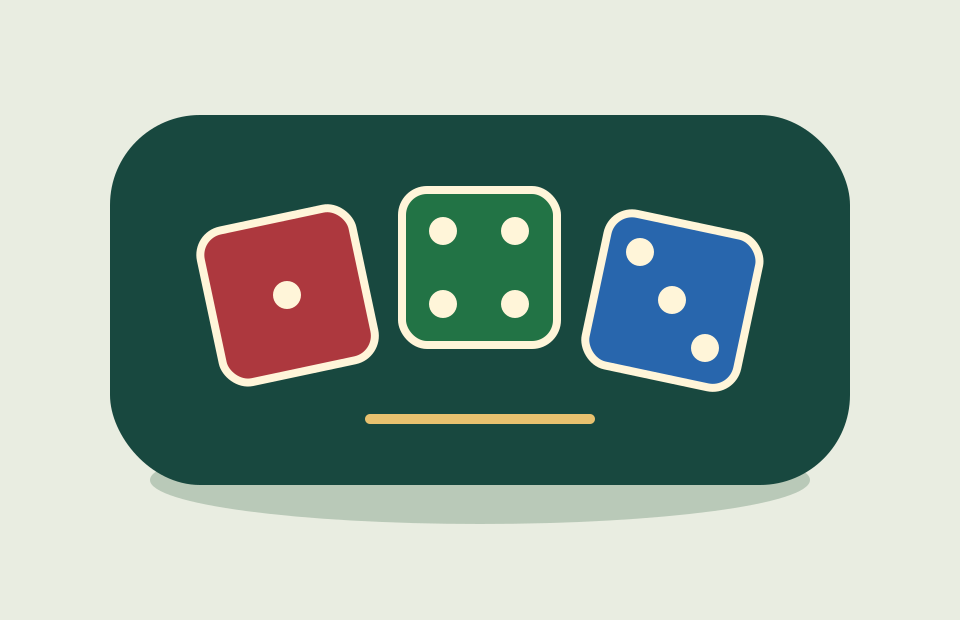
The idea behind itPractice choosing well when the next result is uncertain.
How Rainbow Dice works
You have five dice and up to three rolls per turn. Hold any dice you want to keep, reroll the others, then score one unused category. There are 17 turns: 13 number-based categories and four color categories. Every rerolled die independently receives a number from 1 to 6 and a red, green, or blue color. Held dice keep both.
Three and four of a kind score the total of all five dice. A small straight scores 30 and a large straight 40. A number full house requires exactly a three-plus-two split and scores 25. Five matching numbers score 50, or 100 when all five also share one color. Each single-color flush and the color full house scores 35. The upper-section bonus is 35 for reaching 63.
This version has no repeated five-of-a-kind bonus or joker rules. Play a 17-round match against the computer, or use Practice mode for a solo scorecard. The computer is a heuristic opponent labeled Average, not an optimal solver.
The philosophy: judge the choice before the result
A risky reroll can succeed after a poor decision. A sensible hold can fail. The useful question is what you knew when you chose: which categories were open, how many rolls remained, and what you gave up by pursuing one result.
That is the connection to poker thinking. You practice comparing uncertain outcomes, keeping alternatives open, and reviewing a decision separately from whether you got lucky. These are habits a poker player can rehearse here; playing Rainbow Dice does not establish improved poker results.
Where the poker parallels help
Made hands and draws. Keeping a scoring combination or breaking it to chase a better one resembles choosing between present value and potential improvement. Number straights and full houses are familiar shapes. The single-color categories play a role similar to a flush, although their probabilities differ from card poker.
Expected value. A high possible score is only part of the calculation. Its chance of arriving, fallback scores, and the value of spending that category all matter. A category used now is unavailable for the rest of the game.
Position in the match. When trailing late, you may prefer a line with a chance of a larger score over a steadier result that cannot close the gap. When ahead, preserving a reliable scoring option may better serve the goal of winning. Maximizing expected points and maximizing the chance of winning are not always the same objective.
A one-roll odds example
Suppose you hold four red dice and have one roll left. The rerolled die has a 1-in-3 chance of being red, completing the red flush. That is a 35-point category, so the flush-only expected contribution is 35 / 3, about 11.67 points. Failure contributes zero to that particular calculation; another open category may still score.
Now hold four sixes instead. A final die has a 1-in-6 chance of becoming a six. If that last die must be both red and a six, its independent number and color produce a 1-in-18 chance. These are specific targets on one roll, not the odds of any flush or any five of a kind from a fresh turn.
What this teaches, and what poker adds
Before rerolling, name your target, one fallback, and the category you would spend. After the turn, ask whether that choice made sense with the information available. Repeat the exercise in Practice mode without a match score pulling your attention toward one outcome.
Rainbow Dice gives you open dice and scorecards. It does not reproduce poker's hidden cards, betting, pot odds, bluffing, or opponent ranges. It offers a smaller setting for probabilistic decisions and score-dependent risk choices. Poker adds strategic interaction around information and bets.
Rainbow Dice is an independent game with original artwork. Yahtzee is a Hasbro game; the comparison describes the familiar mechanics, not an affiliation.
Further reading: Hasbro's standard Yahtzee rules.
Try the decisions for yourself
Play a match or use Practice mode to compare your decisions.
Play Rainbow Dice